Four states, not one
“Unavailable” is not a useful category. It bundles together four situations that have completely different causes, different costs, and different things you would do about them.
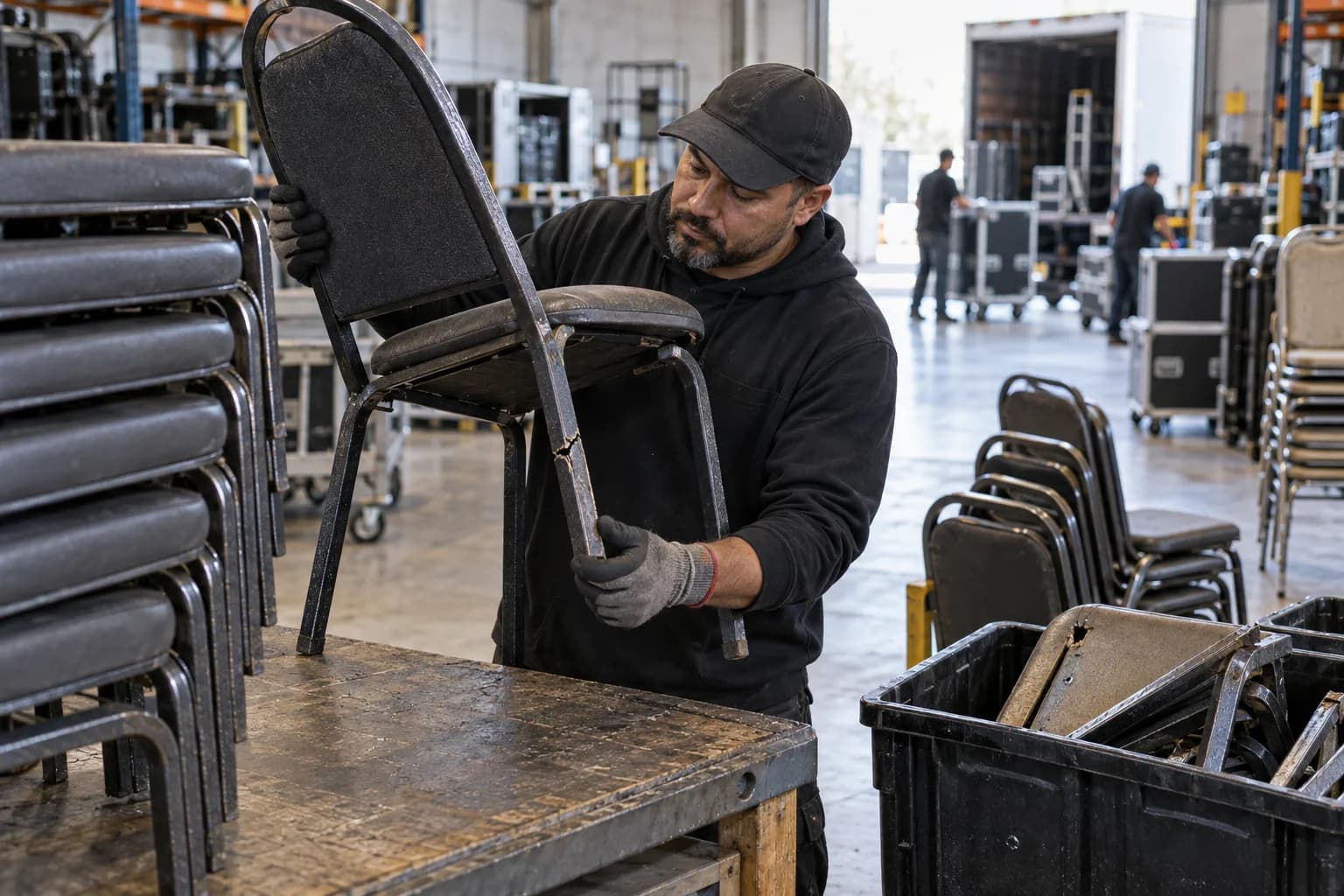
- Damaged - physically broken, torn or stained. It exists, you can see it, and it cannot go to a customer. It may or may not be worth fixing.
- In maintenance - currently being repaired, laundered or serviced. It is coming back. The only question is when.
- Missing - it did not come back and nobody knows where it is. Not broken. Not written off. Simply absent.
- Retired - written off deliberately. Kept on the books for history, never going out again.
Collapse these into one bucket and you lose the ability to answer the only questions worth asking. Is this line of stock badly made, or badly handled? Is my repair queue too slow, or is my breakage rate too high? Am I losing chairs at events, or in my own building?
Four pools, each with its own count, is the whole technique. Nearly everything else follows from it.
Why missing deserves its own column
Of the four, missing is the one most often folded into damaged, and it is the one where that hurts most.
They have opposite causes. Damage is a handling and durability problem: something got dropped, or the material was not up to the job. Missing is a process problem: something was not counted out, or not counted back, or was left at a venue, or is on the wrong shelf in your own warehouse.
They also have opposite remedies. Damage is answered by better packing, better training, or buying a sturdier product. Missing is answered by counting at both ends of the journey - and quite often by a proper search, because a decent share of “missing” stock is sitting somewhere in the building under something else.
One practical consequence: keep missing stock as missing for a while before retiring it. Items reappear. A stock count in the linen room finds the box that went astray in June. If you wrote them off immediately, you now have a positive discrepancy nobody can explain, and unexplained discrepancies are how people stop trusting the numbers.
Record condition at the moment of return
This is the single highest-value habit in the whole subject, and it is worth being blunt about the cost of skipping it.
If you record damage a week later, you have lost the ability to attribute it. Nobody remembers which of the three weekend events the broken chair came back from. So the damage becomes general wear, and general wear is nobody’s responsibility - which means it never gets discussed with the customer, never gets charged for, and never gets fixed at the source.
If you record it at the receiving bay, while the van is still being unloaded, you know:
- Which booking it came back from.
- Which venue it went to.
- Who checked it in.
- What the actual condition was, before anybody moved it.
That is enough to see patterns. One venue that returns damaged glassware every time. One item that breaks constantly regardless of who has it. One kind of event that is consistently hard on your linens. None of those are visible in an annual total; all of them are visible in a few months of per-return records.
The counting rule from organising the warehouse exists to protect exactly this: nothing goes back on a shelf until it has been counted and its condition recorded.
Every change needs a reason attached to it
A quantity that changed without a record of why is indistinguishable from a typo, and once a business has a few of those, people begin keeping private spreadsheets again.
So every movement between pools should write a row: what changed, by how much, from which pool to which, when, who did it, and why. Not as an optional log somebody remembers to fill in - as part of the same operation, so that a change without a record is not possible.
That gives you two things worth having:
- An answer to “where did the other six go?” You can walk backwards through the history until the number stopped making sense, and see what happened at that point.
- Accountability without suspicion. When every change is recorded as a matter of course, the record is a normal part of the work rather than an accusation. That is the difference between a team that records honestly and a team that quietly rounds things.
One nuance worth getting right: a correction is not the same as a movement. If a count reveals you have 38 chairs and the system said 40, that is a correction to what you own, and it should be recorded as one - not disguised as two chairs being damaged. Mislabelling corrections as damage inflates your breakage rate and hides your real loss rate, which is precisely backwards.
Separate moving stock from changing what you own
There is a meaningful line between two kinds of change, and most systems do not draw it.
Moving units between pools - this chair is damaged now, these linens have gone for washing - is an observation. The warehouse floor makes it, constantly, and it should be as easy as possible. Nothing about it changes how much the company owns.
Changing the total owned - writing off ten chairs, adding forty new ones, accepting a count discrepancy - is a decision. It changes the value of the business, and it belongs with whoever is accountable for that.
Drawing the line here means the floor can record what it sees without anybody worrying about what that lets them do. The count is submitted by the person holding the clipboard, and accepted by somebody in the office. Both halves are recorded, and the discrepancy is visible in between - which is the bit that gets skipped when one person does both, and the bit that actually tells you something.
What to actually measure
Once the four pools are separate and the changes are recorded, a handful of figures become available. These are the ones that change decisions:
- Loss rate per line, per season. Missing units as a share of units sent out. This is the number that tells you whether your check-out process is working.
- Breakage rate per line. Damaged units as a share of units sent out. Compare across similar items - two kinds of chair with very different rates is a purchasing conversation.
- Time in maintenance. How long stock sits in the repair queue. Every day there is a day it could not be rented, and a long queue is often cheaper to fix than buying more stock.
- Replacement cost of the gap. Missing plus written-off, valued at what it costs to replace. This is the number that justifies spending money on the process.
Notice that all four are ratios or durations, not totals. “We lost 40 chairs” is not actionable. “We lose 2% of chairs sent out, and 6% of glassware” tells you exactly where to look.
Where to start
If none of this exists in your business today, do it in this order. Each step is useful on its own, so you get value before you finish.
- Split the pools. For each item, four numbers instead of one. Do it once, honestly, even if the first pass is a guess.
- Record condition at the receiving bay. Before anything goes back on a shelf. This is a process change, not a software change, and it is the one that pays for itself fastest.
- Attach a reason to every change. Even a one-line note is enough to make a history readable later.
- Separate counting from accepting. Two people, two steps, and a visible discrepancy in between.
- Look at the ratios once a season. Not the totals.
The point of all of it is to move loss from something you discover to something you manage. It will not go to zero - rental stock gets used hard, and some breakage is simply the cost of the business. But the share of it that is a process problem rather than a physics problem is usually much larger than people expect, and it is only visible once damaged, missing, in maintenance and retired stop being the same column.
How Event Managr models the pools shows the seven figures they reconcile into, and the warehouse side covers the count-and-accept cycle and the audit trail.