Design for flow before you design for storage
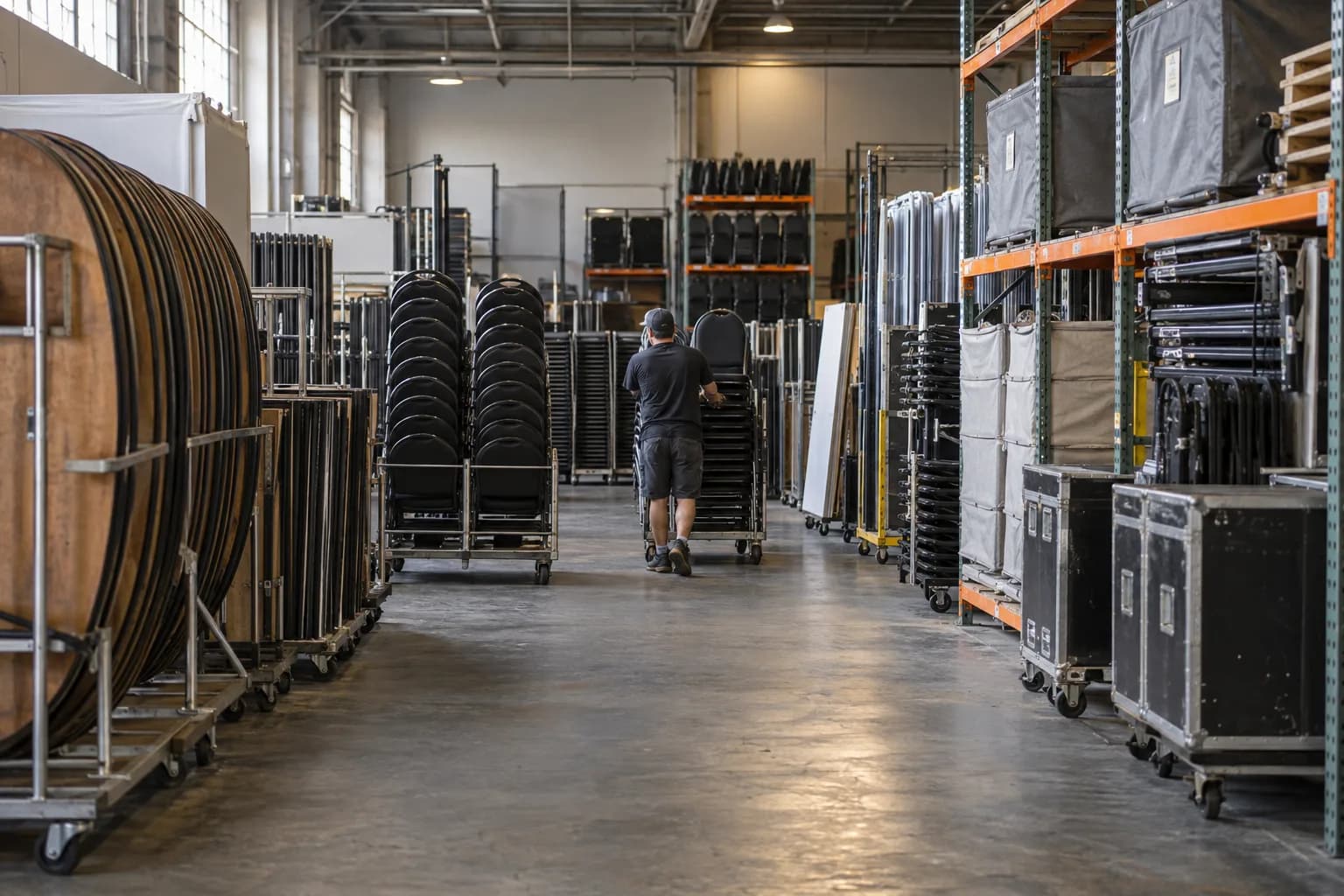
The instinct is to start by deciding where things live. Start instead with how things move, because the layout that minimises walking on a Friday afternoon is worth more than the one that maximises shelf space.
Almost every rental warehouse has the same four flows:
- Picking - pulling a booking’s stock together, usually the day before it goes out.
- Staging - that stock sitting somewhere, assembled and checked, waiting for a van.
- Receiving - everything coming back at once, typically Sunday evening or Monday morning.
- Processing - cleaning, repairing, counting, and putting away.
Two of those are peaks and two are steady. The mistake almost everyone makes is giving no floor space at all to staging and receiving, because they feel like wasted space on a Tuesday. Then on Sunday the returns land in the middle of the picking aisle and Monday is spent untangling it.
Reserve the space. A rental warehouse that is 80% full and has a clear receiving bay runs better than one that is 95% full and does not.
Zones answer which end, positions answer which shelf
This is the distinction that makes a location system usable, and getting it wrong is the most common way a warehouse ends up with a filing system nobody uses.
A zone is a big area of the building. Four to eight of them, total. Zone A, Zone B, the Linen Room, the Yard. Their job is to answer the first question anyone asks, which is which direction to start walking.
A position is where it sits once you are there: Aisle 3, Shelf B. Rack 4. Container 2.
Together a row reads like directions:
ZONE A · AISLE 3, SHELF B
The failure mode is creating a zone per shelf. It feels more precise, and it destroys the system: with sixty zones, the zone filter returns one item per option and stops being a filter at all. Worse, nobody can remember sixty names, so people stop writing the location down and you are back to asking whoever put it away.
Keep the zone count small enough that a new member of staff learns all of them on their first day. If you cannot, the building needs signs, not the database needs more rows.
Group stock by how it behaves, not by what it is
Catalogues group by category because customers browse that way. Warehouses should group by handling, because staff move that way. The two are not the same, and following the catalogue into the building is a quiet source of wasted time.
The groupings that actually earn their keep:
- Goes out together - if chairs and chair covers are almost always on the same booking, storing them at opposite ends doubles the picking walk for no benefit.
- Heavy and low. Staging, flooring, generators. Ground level, near the door, near the vehicle.
- Fragile and high-value. Glassware, lighting, anything that a forklift near it makes you nervous. Away from traffic.
- Needs a controlled environment. Linens and drapes want dry and dark. A damp corner will cost you a whole line of stock over a winter, and you will not notice until you unfold it in front of a customer.
- Rarely moves. Seasonal decor, the marquee you own for one event a year. Put it high and at the back. This is the only category where density beats accessibility.
Give returns their own bay, and their own step
The return is the moment the truth about your inventory changes. Everything you know about what you own is either confirmed or invalidated when a van comes back, and if that moment is rushed then the record is wrong for the rest of the month.
The rule that fixes most of it: nothing goes back on a shelf until it has been counted and its condition recorded.
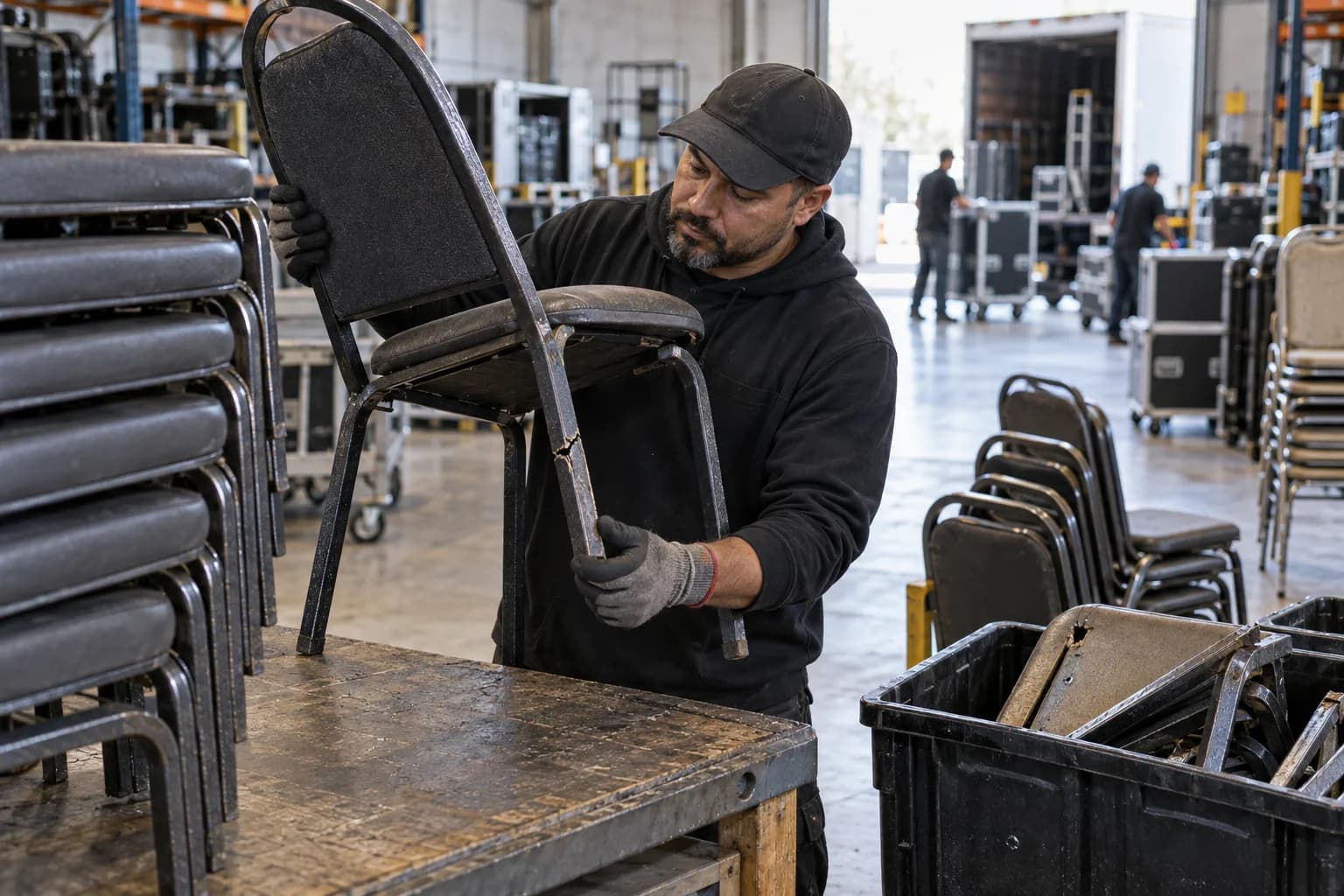
That is why the receiving bay is not optional. It is the physical embodiment of that rule - a place where returned stock is allowed to be in an unknown state, so that the shelves are allowed to be in a known one. Without it, unchecked stock goes straight back into the racking and the damaged chairs are discovered by the next customer.
Three lanes off the receiving bay is usually enough:
- Ready - counted, fine, goes back to its position.
- Needs work - washing, repair, a missing part. This is your maintenance pool, and it should be a physical place as well as a number.
- Write-off - beyond repair. Record it and remove it from the total, so it stops being counted as stock you can promise.
Recording condition at the moment of return is also the only time you can reasonably attribute damage to a booking. A week later, nobody remembers which event the broken leg came back from.
Count continuously, not annually
The annual stocktake is a ritual inherited from retail, and it suits rental badly. It is disruptive, it happens when the building is fullest of returned stock, and it tells you the size of a discrepancy long after you could have found its cause.
Cycle counting works better: count a small part of the warehouse often, on a rotation, so everything gets counted several times a year without anything ever stopping.
A workable rotation:
- Weekly - your highest-turnover lines. Chairs, tables, linens. The ones that move every weekend are the ones that drift fastest.
- Monthly - everything with a meaningful replacement cost.
- Quarterly - the long tail.
Count on the quiet day. For most rental businesses that is Tuesday or Wednesday: the weekend’s returns are processed and the next weekend’s picking has not started.
One process point matters more than the schedule: separate counting from accepting. The person on the floor records what they see. Somebody with the authority to change what the company owns reviews the discrepancy and accepts it. This is not bureaucracy - it is what turns a count into a decision rather than an unexplained overwrite, and it means a miscount gets caught by a second pair of eyes instead of silently becoming the new truth.
Label for a glance, not for a scanner
Warehouse labels get read in bad light, at a distance, by somebody carrying something. Design them for that and nothing else.
- Big and high-contrast. Zone signs should be readable from the door. If you have to walk up to a sign to read it, it is doing half its job.
- Short codes. A code somebody has to read twice is a code they will guess at. Keep them short enough to hold in your head for the length of an aisle.
- Codes that mean something. CHI-040 beats a random string. It survives being half-rubbed-off, which random strings do not.
- Label the location as well as the item. The shelf should say what belongs on it. That is how a gap becomes visible as a gap, rather than as empty shelf.
Keeping it organised after the first busy weekend
Any warehouse can be organised on a quiet Monday. The question is whether the layout survives a Saturday with three events going out and two coming back, when everybody is behind.
What holds up under pressure:
- A place for everything, marked. Under pressure people put things where there is space. Marked positions make the right space the obvious one.
- Fewer rules, applied always. A five-rule system everybody follows beats a twenty-rule system followed on Tuesdays.
- Recording at the point of action. If the count has to be written on paper and typed up later, it will not be. The system has to be usable from a phone, standing up, in the aisle, with gloves on - which is a genuine design constraint and not a nice-to-have.
- Ten minutes at the end of the day. A short reset is sustainable. A three-hour reorganisation once a quarter is not, and it never gets booked.
None of this is exotic. It is mostly deciding once, marking it clearly, and then making the correct action the easy one at the moment somebody is deciding what to do with an armful of chairs.
How Event Managr handles warehouse operations covers zones, positions and the count-and-accept cycle, and tracking damaged and missing stock picks up where the receiving bay leaves off.